Sunday, November 21, 2010

Independent Research Report – Savera Industries Limited

Chennai-based Savera Industries Ltd (Savera) is a hospitality player incorporated in 1968. It owns and operates a 230-room four-star deluxe hotel in Chennai. Preferring to concentrate all business energy on this one property, it does not have any major expansion plans. We assign Savera a fundamental grade of ‘2/5’, indicating that its fundamentals are ‘moderate’ relative to other listed securities in India.

Hotel in the heart of Chennai provides a steady stream of cash flows

Savera Hotel is located in Mylapore, in the heart of Chennai, in close proximity to the airport, railway station and tourist spots. With the aim of attracting business travelers, it offers all modern amenities such as conference room, board room, banquet hall and Wi-Fi connectivity. The hotel has had a good influx of business travelers over a period of four decades as reflected by its occupancy rates (OR) and average room revenue (ARR) resulting in steady stream of cash flows. Although the ORs were low in FY09 and FY10 (47%), the economic revival has pushed it back to higher levels. Savera reported an OR of 68% in the first half of FY11. We expect a similar rate for the full year.

Improving industry outlook a positive

With an improvement in the domestic economy, the hotel industry is back on track with a sharp rise in room demand. Industry sources expect room demand to grow by 13-15% over FY10-12. Moreover, even though there are supply concerns in the premium hotel segment there is not much supply coming in the mid-market business segment where Savera is positioned.

No immediate expansion plan

Apart from the plan to acquire a 30-room budget hotel at an estimated cost of Rs 60 mn (Rs 2 mn per room) in Bengaluru, Savera has no major expansion plans. It is focused on profitably running the Chennai hotel. While this would result in steady cash flows, we believe it would not result in any substantial value creation for shareholders in the long term.

PAT to grow at a two-year CAGR of ~50%; EPS to more than double

We expect Savera to post a PAT CAGR of 50% from Rs 25 mn in FY10 to Rs 57 mn in FY12 driven by revenue growth and margin expansion. Revenues are expected to increase at a two-year CAGR of 12% to Rs 442 mn in FY12 while net margins are expected to improve from 7.2% in FY10 to 11.3% in FY11 and to 12.9% in FY12. We expect EPS to increase from Rs 2.1 in FY10 to Rs 4.8 in FY12.

Valuation - the current market price has strong upside

We have valued Savera on an EV/adjusted room basis. We have given a multiple of Rs 4.5 mn on EV/adj.room which translates into a fair value of Rs 73 per share. We initiate coverage on Savera with a valuation grade of ‘5/5’, indicating that the market price has ‘strong upside’ from the current levels.

RPP Infra Projects IPO : Analysis


RPP Infra Projects Limited is entering into primary market with an Initial Public Offer (IPO) of 6,500,000 Equity Shares of Rs 10 each. The IPO is opening on 18th Nov 2010 and the shares will be available for subscription up to 22nd Nov 2010. The price band for the issue has been fixed at Rs. 68 – Rs. 75 Per Equity Share. RPP Infra Projects Limited is in thebusiness of infrastructure development such as Highways, Roads and Bridges. Company is also involve in civil work like SEZ Development, Water Management projects, Irrigation and Power Projects.

The objects of the issue are to fund the capital expenditure, provide for working capital margins, to fund an SPV for proposed BOT projects and for general corporate purposes.

Company Financials:-
(Rs in Crores)

For the year ended 31-Mar-10For the year ended 31-Mar-09For the year ended 31-Mar-08For the year ended 31-Mar-07
Total Income146.88101.2272.1344.67
Profit After Tax (PAT)8.264.122.051.86

Risk Factors:-
1. Rating agency FITCH has given IPO grade 2 which shows a Below Average Fundamentals.
2. The company plans to enter into BOT/BOOT segment. This segment is highly competitive and as company has no past experience of executing BOT projects, it would be very difficult to get in.
3. In the past, the directors of the company have attracted disqualification under Sec 274 (1) of the Companies Act.
4.The objects for which the funds are intended to be raised have not been appraised by any bank or financial institution.

Valuation and Recommendation :-
At the price band of Rs 68-75, the company is demanding a valuation of 18x on its FY11 earnings, on the post issue expanded capital of Rs 22.60 crores, which is expensive, for a mid sized company. Several other companies like J Kumar Infraprojects Ltd. with market cap. of Rs 652.05 crores and Pratibha Industries Ltd. with market cap. of Rs 706.96 crores are available at much cheaper valuation in the same segment. BOT segment is highly competitive and for a new entrant it will take a long time to stablish itself. So if you are looking listing gain then AVOID subscription.

FD? or FMP?

Dear Investor,


Most of us park our money in fixed deposits unaware that tax on interest earned can be as high as 33.99%! That’s why Fidelity’s Fixed Maturity Plan makes sense. The fund will aim to provide reasonable returns at minimal risk by investing in a quality portfolio of fixed income securities with maturity periods that are mostly in line with its own. And, you pay as little as 22.66% tax with indexation or 11.33% without it! Check out the table below.

FD? or FMP?

* Pre-tax yield (illustrative) based on returns from securities rated P1+ /AAA / its equivalent (net of expenses)
**Illustrative inflation assumed based on RBI objective of 7% inflation by Q4 FY09
***Investors have the option of paying a flat 10% tax on their gains if they choose not to take indexation advantage
All rates and returns provided are for Illustrative purposes only

Fixed Deposit

FMP Growth Option for
Retail Plan (with indexation)

Net pre-tax yield (illustrative)

10.00%

10.50%*

Amount invested

100000

100000

Tenure

370 Days

370 Days

Indexed value - FY09 (at 7%** assumed inflation)

NA

107000

Taxable Income/Capital Gains

10137

3644

Income Tax/Capital Gains Tax***(%)

33.99%

22.66%

Income Tax/Capital Gains Tax (Rs.)

3446

826

Post Tax Maturity Value

106691

109818

Post Tax Yield

6.69%

9.82%

your investment of Rs.18100 would now have gone to, hold your breath, Rs.3,26,888!!!!!

Dear sir,
I am in awe of your writings and would appreciate if you can guide a poor man like me. My earnings don’t leave with enough savings. Still, with great sacrifice on my part, I can invest 700rs per month. Is this too little? Should I consider investing in safe options like Bank FD; insurance, etc…Guide me to have some decent lump sum in around 20-25 years time. Please.
Thanks,
Nisarg


Dear Nisarg,
First of all, I appreciate your effort to save the money as "Money Saved is Money Earned"

Saving is nothing but “spending less than earned income”.
Rs.700 is not a small amount at all. Better late than never, better small than no investment at all.
Do you know that if you had invested just Rs.100 in Reliance Growth Fund for the last 181 months, your investment of Rs.18100 would now have gone to, hold your breath, Rs.3,26,888!!!!!
Yes, you read it right…your investment of a paltry of Rs.100 would have grown to more than 3 Lakhs of rupees….!!!!!!


So, if Rs.100 can achieve this much, your Rs.700 too could earn a lot and can easily make you a Crorepati..

Ignore people who tell you to invest in Recurring deposits or buy Gold or even consider Insurance.

Insurance is NOT AN INVESTMENT.

People do not advise you about Mutual Funds because they get ZERO Commission on Mutual Funds where as in Insurance they get about 40% (the recent IRDA has brought this down to about 10%, but still quite a deal) and in Post Office and other investment avenues, they get at the least 2%.

Gold at best gives a return on par with Inflation (even though the last few years have been an exception). With Recurring Deposit, you actually 'LOSE' your Capital when you consider Inflation and Taxes.
The Best option is 'MUTUAL FUNDS".

Reliance, SBI and Sundaram Mutual Funds have SIP for as low as Rs.100.

Sip investments allow you to start small and accumulate huge.
If possible, add another Rs.50 to your savings.
My advise for you is to split this Rs.700 into say about 4-5 Schemes and invest as advised below every month.
My preferred Funds would be
1.Reliance Growth Fund – Rs.100
2.Reliance Regular Savings Fund- Equity – Rs.100
3.SBI Magnum Contra Fund – Rs.100
4. Sundaram Mid Cap Fund – Rs.250
5. SBI Magnum Balanced Fund – Rs.100
6. Reliance Equity Opportunities Fund – Rs.100

These Funds are a Good mixture of Large Cap, Diversified and Balanced Funds with a bias towards Conservative investment.

Friday, November 19, 2010

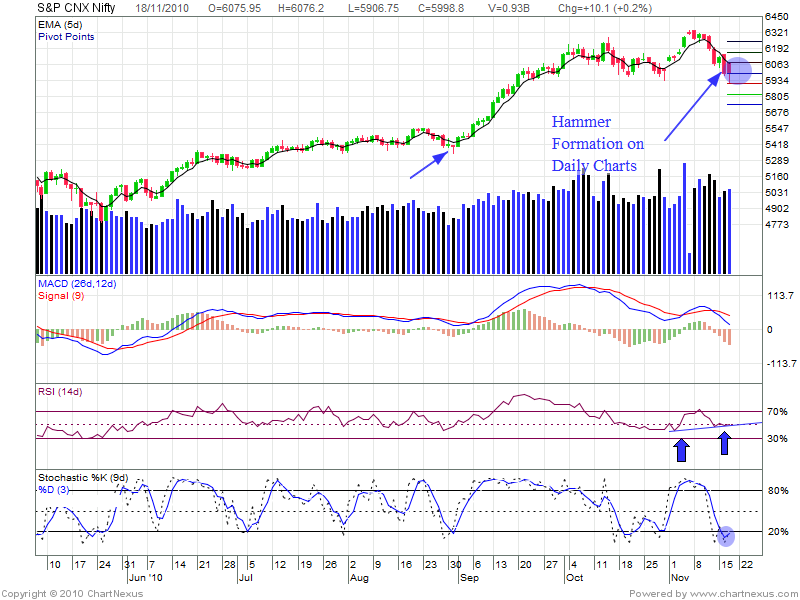
Nifty Forms Bullish Hammer Candelstick Formation

Nifty Forms Bullish Hammer Candelstick Formation


Bullish Hammer

• Direction: Bullish
• Type: Reversal
• Reliability: Moderate

After an established downtrend
• Hammer candles have a small real body that forms at the upper end of the days trading range
• The candle can be either blue or red, analyst usually do not differentiate.
• Lower wick at least twice as long as the real body
• No (or almost no) upper wick

After a bearish sell-off a significant rally brings price back up creating a long bottom wick. By day end buyers are able to push prices back to the upper range creating a short body.

The Hammer pattern signifies a weakening in bearish sentiment. The long lower wick signifies an initial continuation of the downtrend. However, renewed buying sentiment acts as support and drives the price higher to close near its opening price.

• Strength and Confirmation

The strength of a Hammer formation depends on where it appears. If a hammer forms near support levels, then the likelihood of a strong bullish reversal is high. However, if the hammer forms in the middle of a trading range it tends to have little significance. In ideal conditions traders want the wick length to be several times longer than the body of the candle. The longer the candle, the more buyers were able to drive price back up and the stronger the bullish signal this candle provides.

Although traders will usually wait for confirmation the next day, look for buying opportunities to come.


Nifty has shown all the possibility of reversal formation form a low of 5009 which was formed today in panic in morning selling of Telecom Stocks.

I have given a description of Hammer Formation and possiblity of trade on Bullish side.

Now 5 EMA @6075 is the main hurdle for trend to turn to bullish side.RSI is shoing positivr divergence and STOCH is in oversold zone.Recipe for a bullish chart all we need to price to move up 6075 and sustain and close above it

Above 6075 Tgt 6106 and 6179

Wednesday, November 17, 2010

RELIANCE SMALL CAP FUND - SIP WOULD DO WONDERS


AGGRESSIVE FUND FOR HIGH RISK HIGH RETURN INVESTOR

Reliance Mutual Fund have launched an aggressive fund focussing purely on Small Caps aptly named "Reliance Small Cap Fund".

The Fund will be managed by Mr.Sunil Singhania who has had a great success with Reliance Growth Fund.

Small Caps are largely under-researched and the key is to identify companies which can become Large Caps.
Reliance Small Cap Fund will be investing in companies which have a market cap between Rs.170cr to Rs.2200cr.

The Fund will aim to invest in Entry Level Companies which however have a good quality Business Model and has the ability to scale up itself to become Large Cap.

The notable thing is that unlike with their NFOs, this time Reliance have had a low key exposure of this Reliance Small Cap Fund in terms of ads, hoardings. Mr.Shailesh Raj Bhan, Fund Manager of Reliance equity Opportunities Fund said, the low profile was intentional and they were looking at a size of around 500 crore for this fund.
Mr.Shailesh Raj Bhan also indicated they would be looking at a portfolio of around 50-60 companies.

INVESTMENT APPROACH :
The Fund would be doing following up a purely "Bottom Up" Approach and would be less likely to look at Macro View foccussing more on micro view.


COMMENTS & RECOMMENDATION :
Small Caps are very volatile., they tend to rise more than the rest of market in a bull market and likewise fall steeper than the rest in the Bear Market.
Timing your entry and exit from these small caps is imperative and essential to make maximum profit.
DSPBR Micro Cap Fund has done exceedingly well but most probably its close ended nature helped the fund hide the fact of the volatility it had to face.
Sister Reliance Regular Savings Fund-Equity has about 18% exposure to Small Caps and has done exceedingly well even in Bear Market of 2008.

The most notable thing about Small Caps is this, The BSE Small Cap fund has outperformed the Sensex and BSE Mid Cap by a wide margin of more than a huge huge 20% over a 6 year period. That sums up the issue. Yes, Small caps are volatile but they have the potential to become the next multi-baggers if you spot the right one. Who better than the Reliance Star Fund Manager, Mr.Sunil Singhania to do this for you??


Although, Small Caps tend to be very volatile, they can give your portfolio a much needed 'alpha' adding to the overall returns. The volatility associated with small caps tend to get evened out over a period of time. SIP Investment would be the BEST method to maximize your returns from this Fund.

DEFINITELY RECOMMENDED FOR THOSE WHO CAN DIGEST HIGH VOLATILITY.

RECOMMEND INVESTMENT THROUGH SIPS AND/OR INVESTING A SMALL SUM AT REGULAR INTERVALS.

Caveat : Have a minimum of 3 years time frame and Do not have more than 10% exposure to this Fund, even if you are an Aggressive Investor.

Note: Exit load is quite at 2% for redemption before one year., which however, is actually, is beneficial and motivates to stay invested for longer period.

Tuesday, November 16, 2010

Sensex likely to hit 23,500 by end-2011: Prudential Financing

Riding on the solid GDP growth and strong global liquidity flows into the country, the Bombay Stock Exchange's benchmark Sensex is likely to hit the psychological level of 23,500 by end-next year, an international financial sector expert said today.

"We are looking at good gains from the Indian equity market. The Indian equity market is poised for a tremendous growth. Looking forward, I will say the Sensex is likely to reach 23,500 level by December 2011," US-based Prudential Financial Managing Director John Praveen told reporters here.

There will be a strong uptrend in FII inflows as India's economic growth story is very strong, he said.

As per Sebi data, overseas fund houses were net buyers of Indian equities worth $6.42 billion during October, the highest amount pumped in by FIIs in any single month. The total net investment by FIIs now stands at $ 24.79 billion, the highest in a single year.

The developed nations are not growing to their full potential and hence, every one wants to capture the growth story of emerging markets, including India, which is driven by strong domestic demand and solid exports, the expert said.

Sectors such as infrastructure and industry are likely to fare well on the equity markets, he said.

During the first quarter of 2010-11, the Indian economy witnessed a healthy 8.8 per cent growth. The 30-share Sensex today settled at 20,589, down 286.62 points over its last close following mixed corporate results.

Monday, November 15, 2010

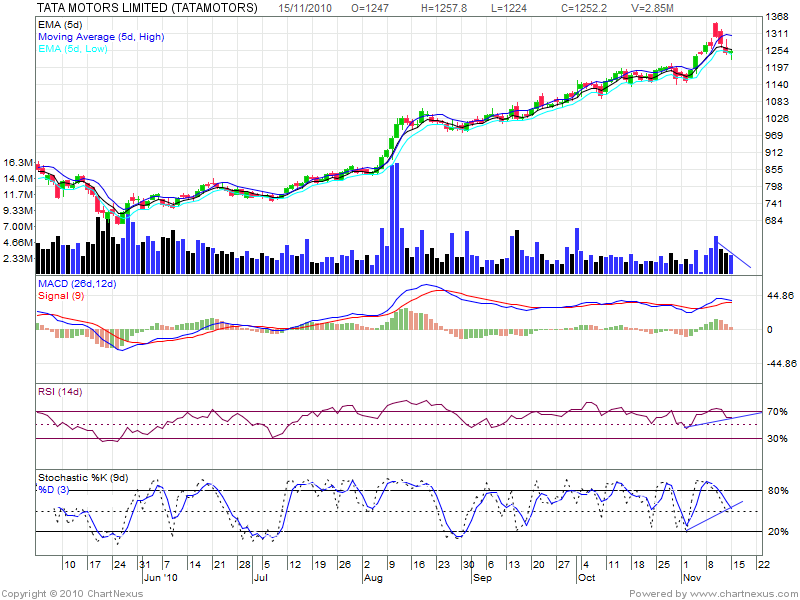
MUNDRA PORT,RANBAXY LABS,TATA MOTORS technical charts

MUNDRA PORT,RANBAXY LABS,TATA MOTORS technical charts


MUNDRA PORT

Mundra Port is forming double bottom formation which if held can see a good upmove till its 50 SMA@160 levels and if it fails to get support at 150 levels can slide till 143 levels on downside.

As technical Indocators are in oversold zone bias is towards upside

Buy above 151 Tgt 153 155 and 156

Sell Below 149 Tgt 148 and 146


RANBAXY LABS

Ranbaxy Labs has broken its solid support of 50 SMA@571 on a low volumes .Well breach on 50 SMA on upside only made the bull run from 460 levels to 610 levels.

If Ranbaxy is able to move above 471 by tommrow on closing basis we can consider today as whipsaw and initiate long positions in the counter.RSI AND STOC are in oversold region

Buy above 571 Tgt 577,588 and 597

Sell below 556 Tgt 547 and 535


TATA MOTORS


Tata Motors trading can be done based of 5 EMA(High,Low,Close) Strategy.


Tata Motors take support around 5 EMA Low @1241.6 and now faces resistance around 5EMA @1265 and after that 5 EMA High @ 1306 levels.

Long should be initiated around 1265 levels for a tgt of 1278 and 1299 and 1306 Sl 1237